
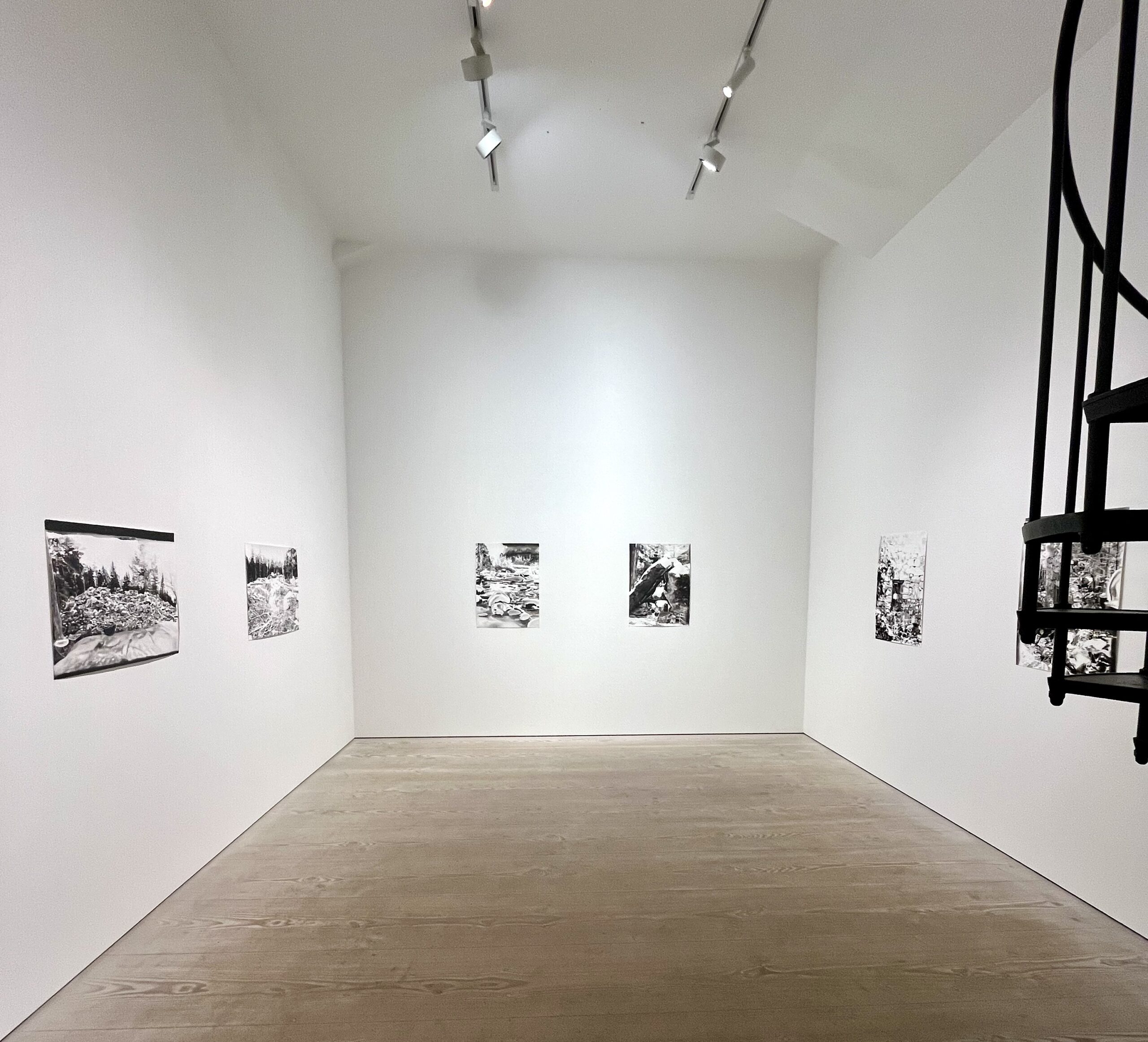
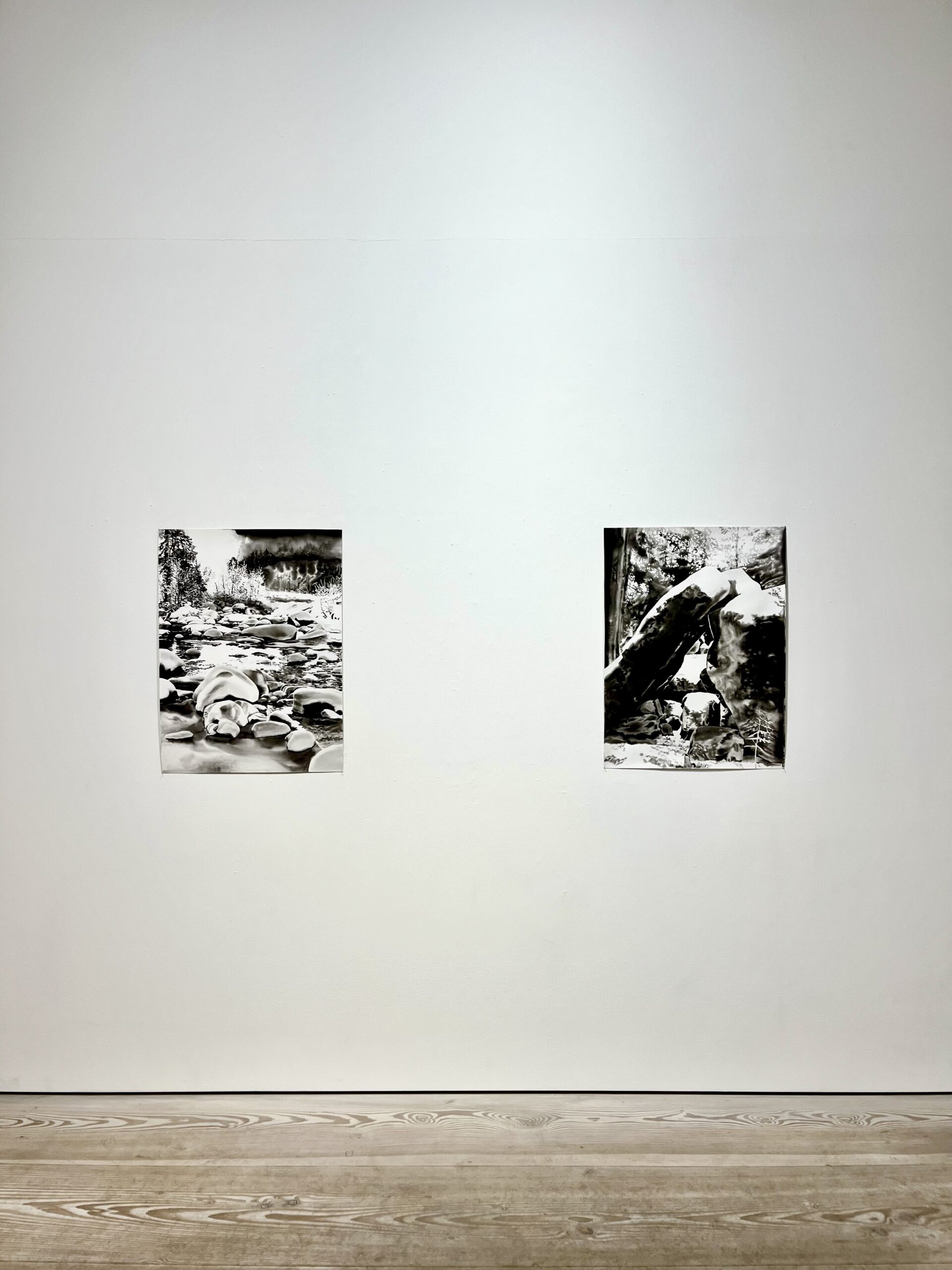
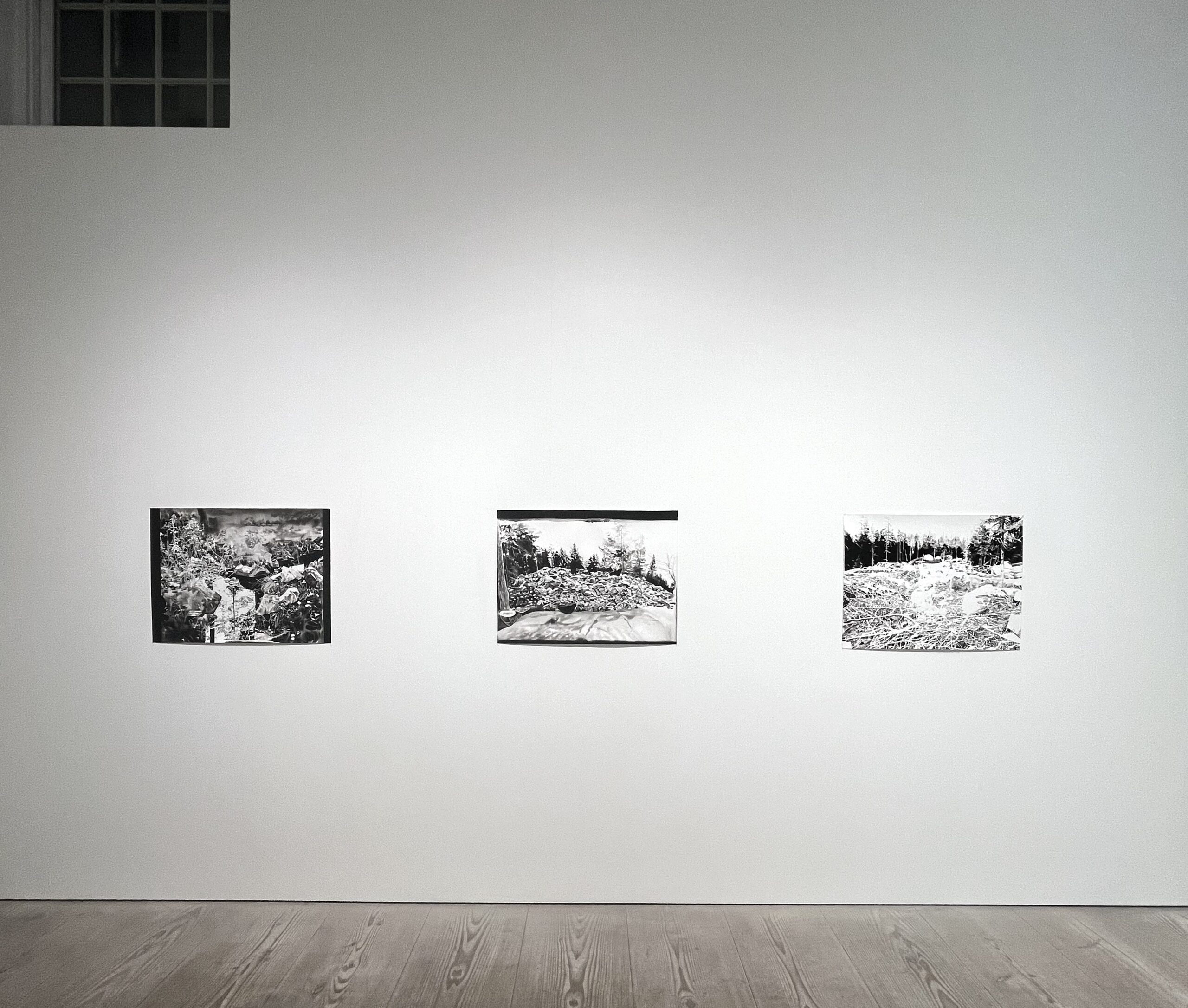
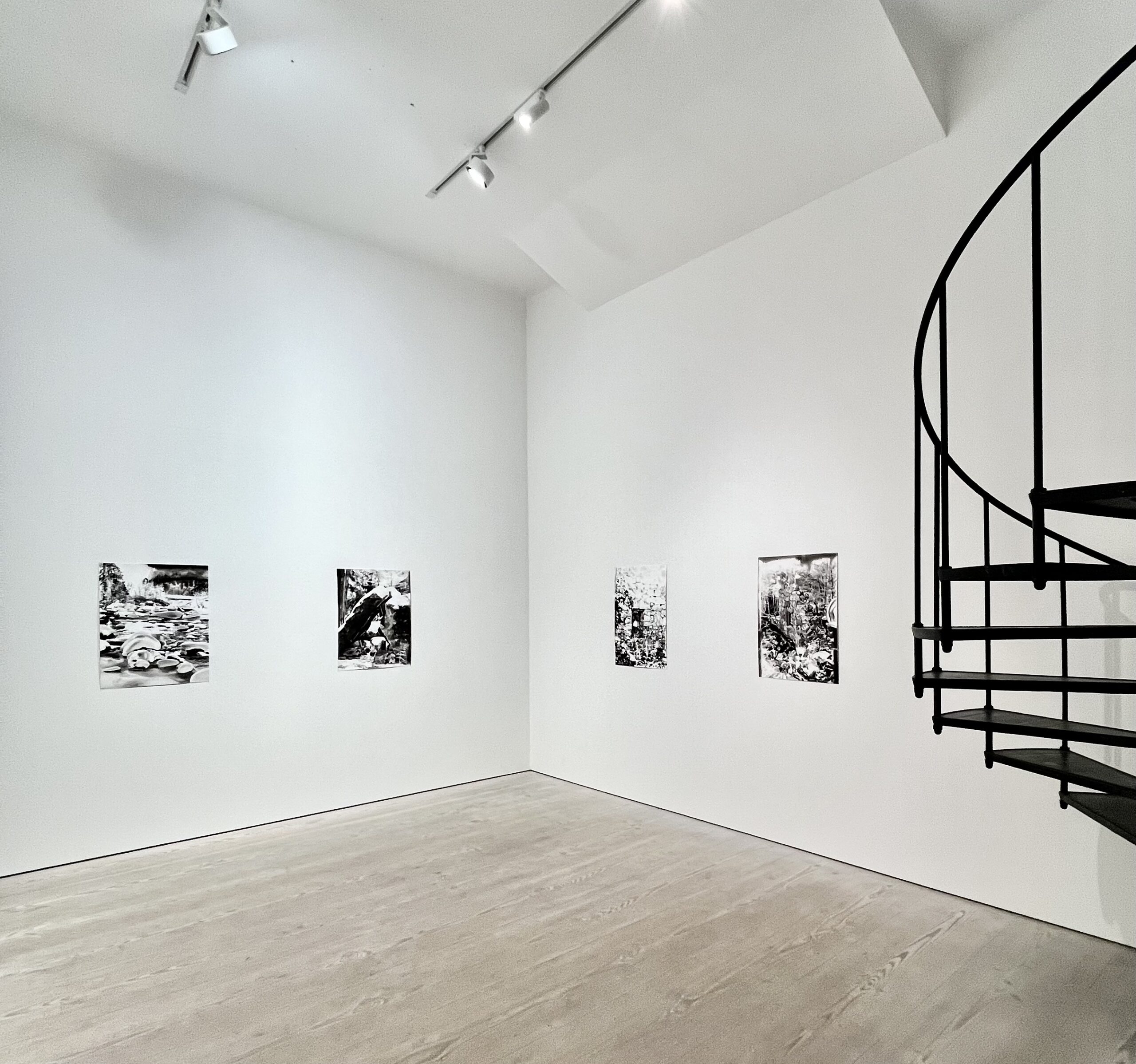
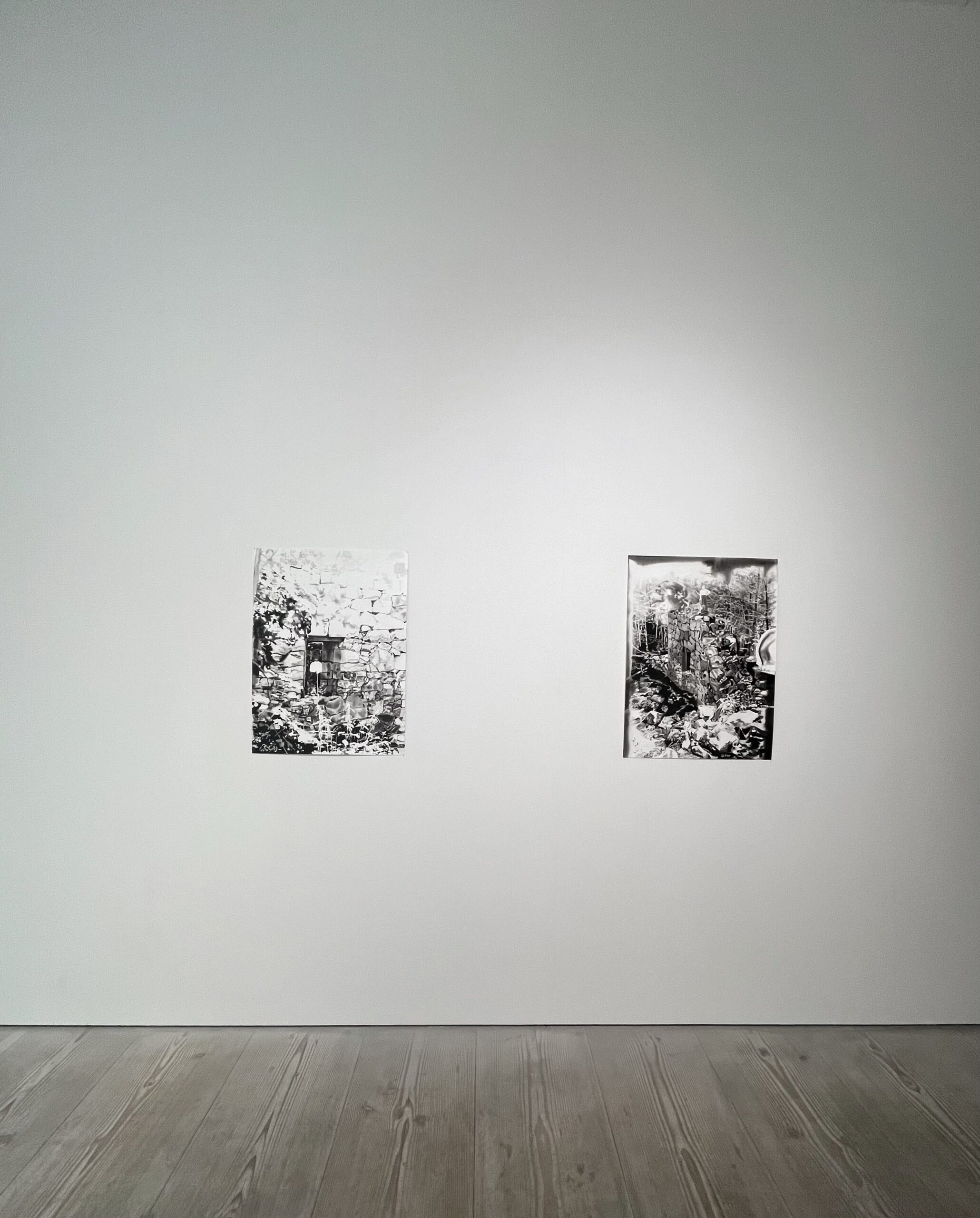
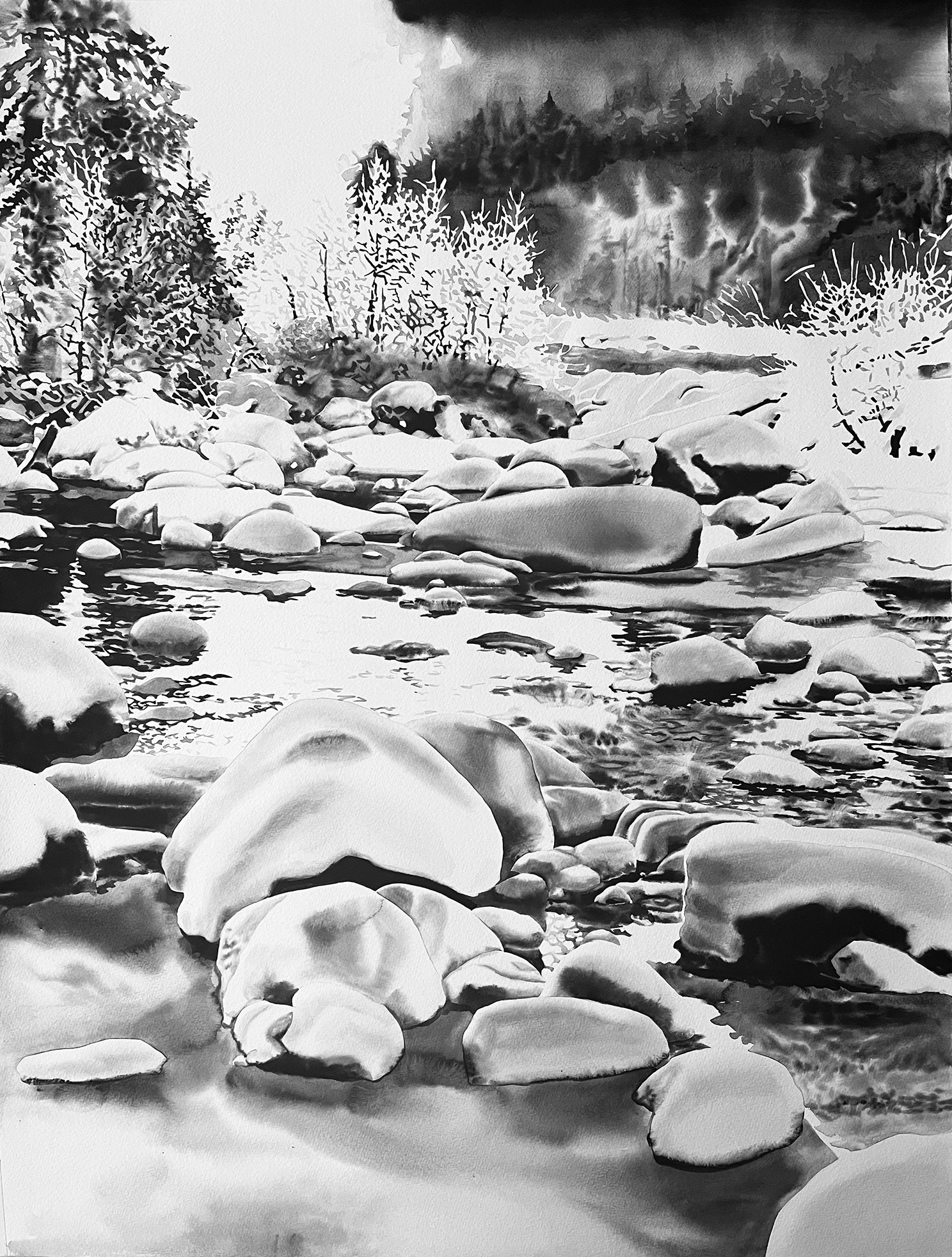

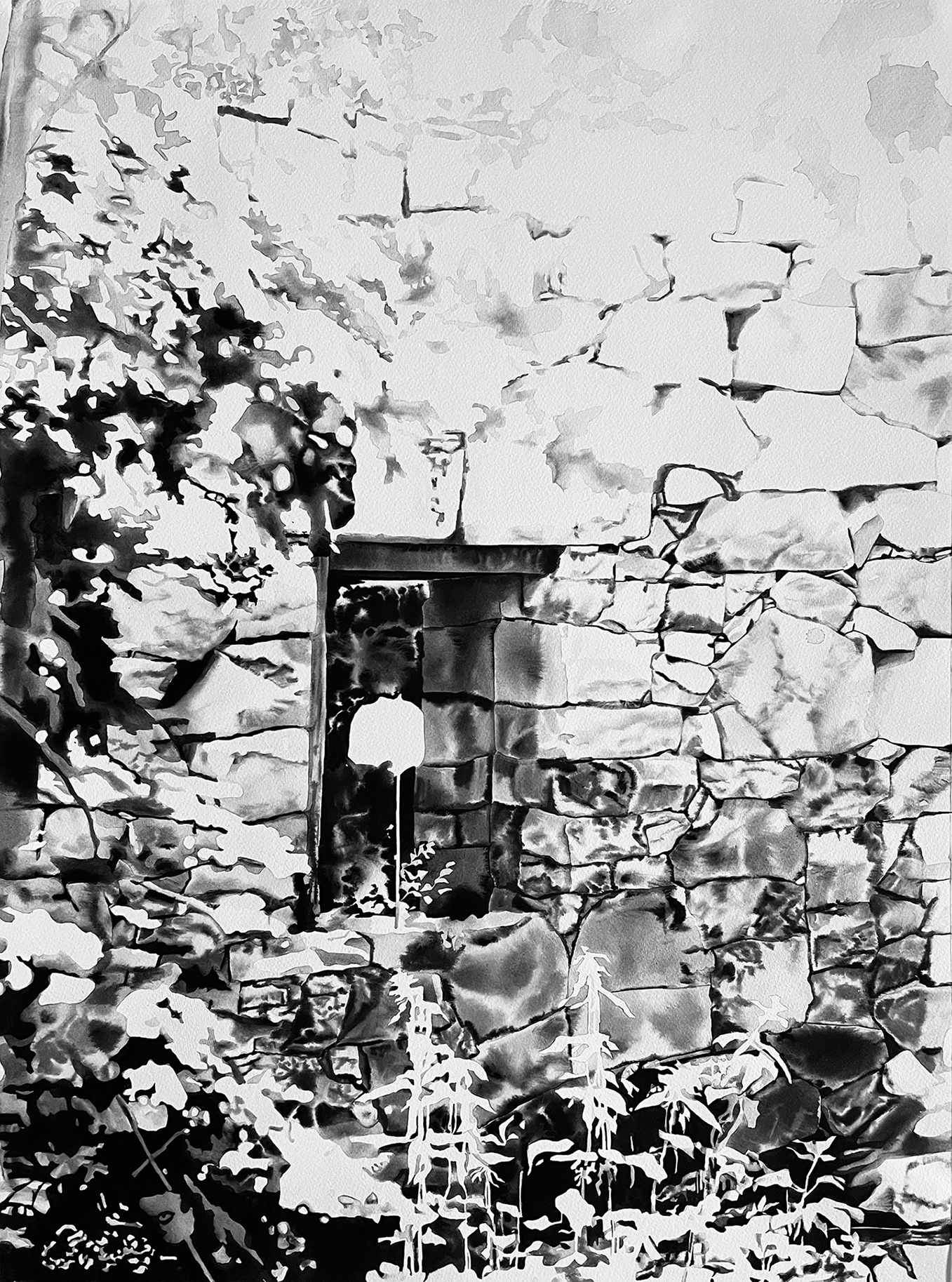
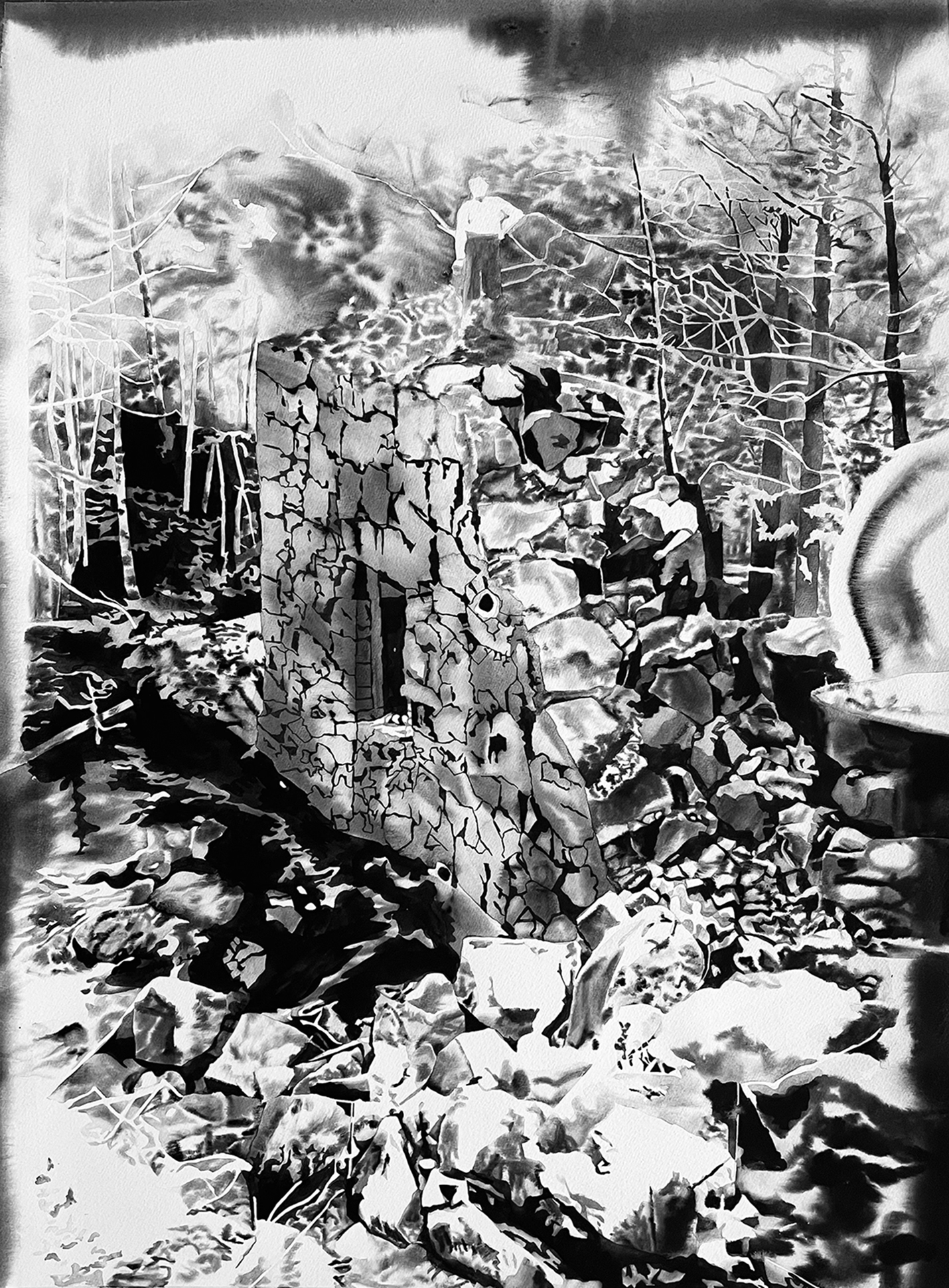
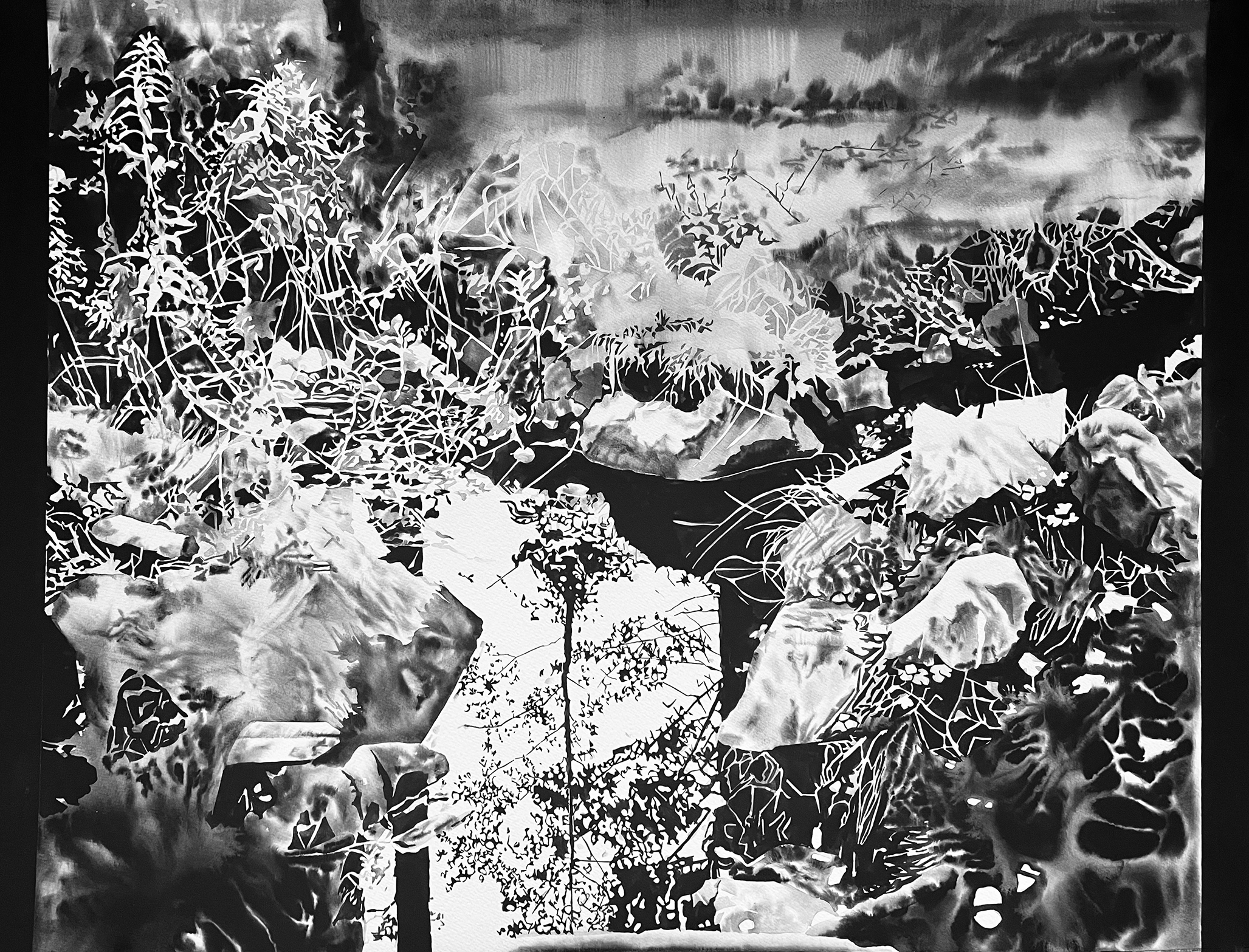
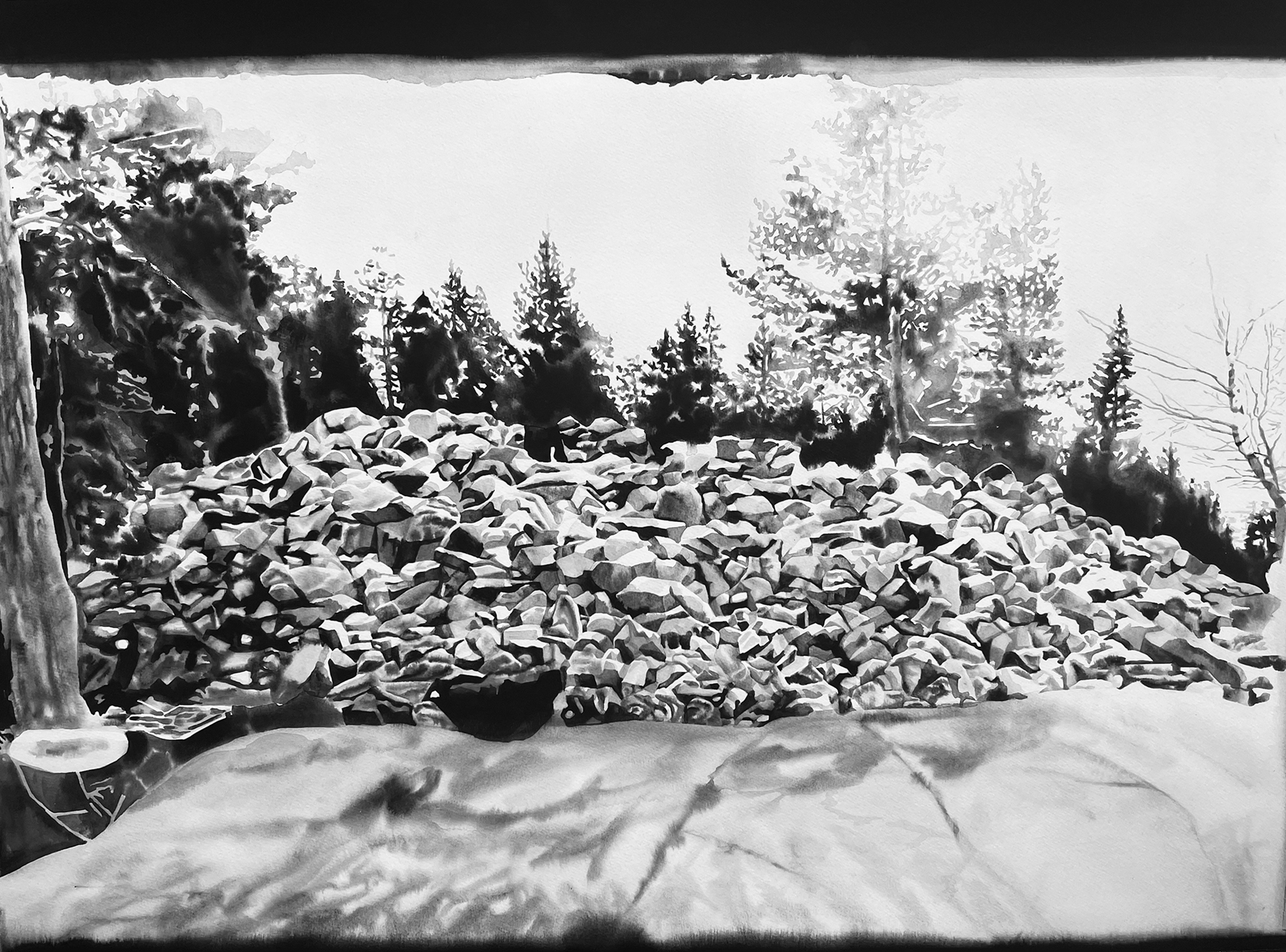
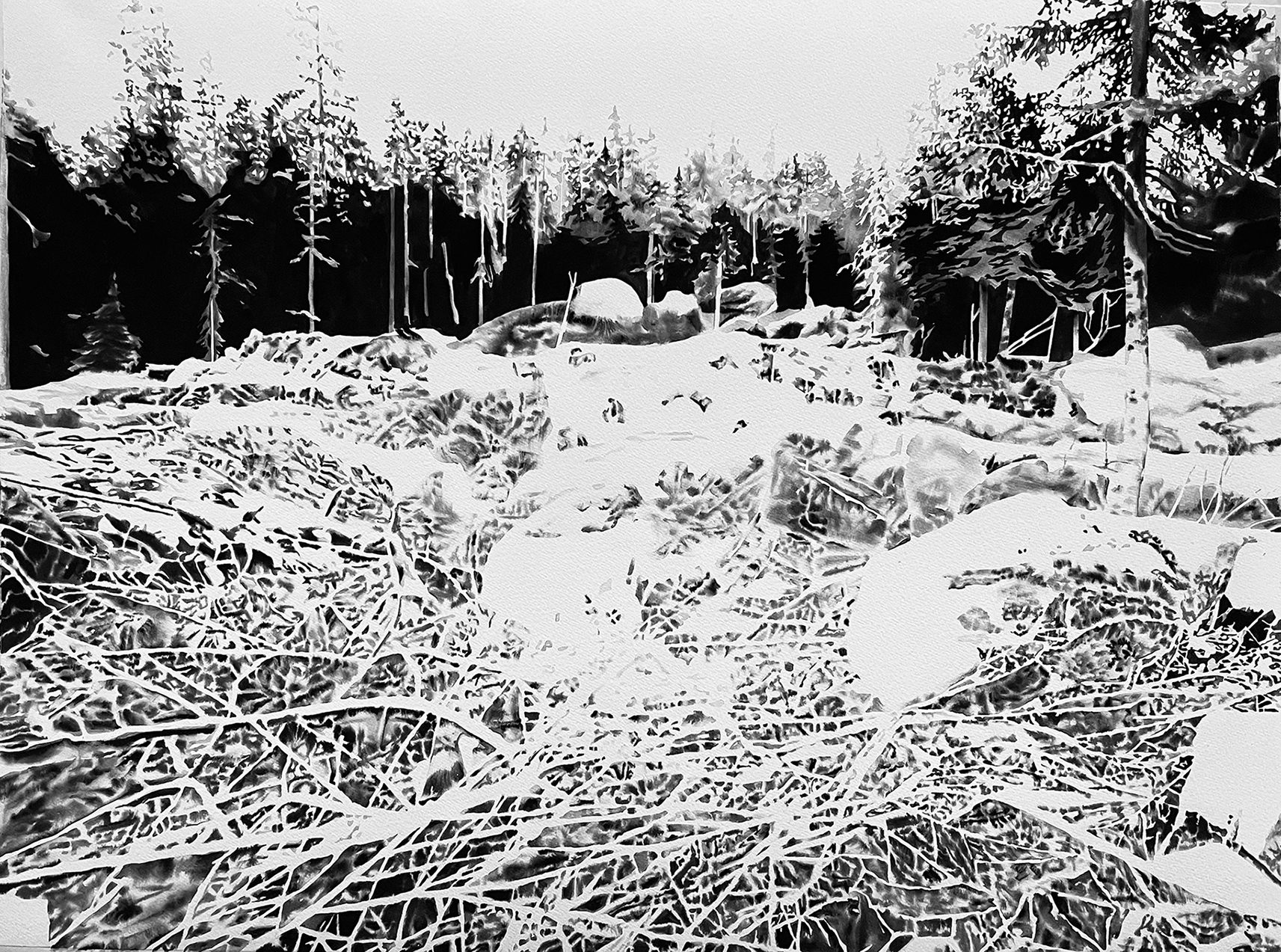
Kristina Bength’s work “Light from the time when the universe became transparent” features seven watercolors that explore how the light and darkness of watercolor paint can create intensity and instability, movement and bustle. As with Martin Ålund, these images are also based on photographs, but in this case the source material is older archive images by unknown photographers. Kristina Bength describes a painterly process in which she, through the movement of the gaze and hand, re-develops the archive images. In the images’ motifs of nature’s swarm of stones, plant life, and people, she finds a challenge in what Barthes describes as punctum, but which she instead transforms into a spectrum. It is about painting with the same intensity across the entire surface of the image, in all directions. Light, surfaces, and structures become equally meaningful, regardless of how or where they appear in the image. In this interplay between light and darkness, chaos and structure, the conditions are similar. The images thus embrace two parallel narratives: on the one hand, their motifs, stemming from 19th-century technological developments and humanity’s accelerated subjugation of nature; on the other hand, painting’s ability to transform everything into a spectrum of light.
The watercolors depict stones in walls, stones being blasted, stones leaning against each other, or in a sharp Y-shaped formation. There are also people observing, climbing, posing, and taking photographs. The paintings have titles such as “Blackbody Radiation,”, “Background Radiation,” and “Absorption.” Between the opaque and transparent surfaces of the watercolors, between the solid and liquid states of stone and water, concepts and descriptions related to Kirchhoff’s law of radiation from 1859 wander—that dark materials glow brighter than transparent ones. Kristina Bength’s work brings to life an imagery that is as much about her own artistic explorations as it is about the history from which they originate.
Kristina Bength, born in 1984 in Falun, lives and works in Stockholm, and has an education from Valand Academy of Fine Arts in Gothenburg and the Royal Institute of Art in Stockholm. She has exhibited at galleries and art halls in Sweden and internationally. She has also worked on independent artistic research projects and participated in collaborations such as “Thinking Through Painting” (Konstakademien, Stockholm 2014), “Rummets rymder” (Uppsala Konstmuseum, 2016) and “Unfold a Place” (Ottilia Adelborgsmuseet, Gagnef, 2018). Kristina Bength’s works are represented in both private and public collections in Sweden and internationally.